In America, we tend to build our places of worship for things like handegg, basketball, and big business.
In England, they built a cathedral for something that
actually deserved it.
 |
| I want to have my wedding here. |
What was that, my friends?
 |
| One of the world's most famous Diplodocus casts. This thing's been around since Carnegie. |
Science.
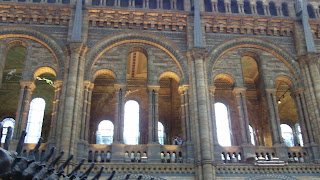 |
| See, we could put the spectators along this gallery, the wedding party on the stairs, stick the officiator next to Darwin (we are not moving Darwin) and then the procession can happen right under that dinosaur... |
|
|
|
|
|
|
|
|
|
In the Great Hall, you can see some of the museum's selected wonders. These include the game-mounted skull of a fantastic Irish Elk, a beautifully preserved coelacanth,
a hybrid tiger, and a glorious dodo skeleton- it's actually complete. Darwin sits in his chair and observes the comings and goings placidly.
 |
| Australian megafauna. |
 |
| Beautiful plesiosaur. Just LOOK at those eyesockets! |
 |
| Prehistoric turtle thing. I forget the name. |
 |
| Not the museum's largest coelacanth, but their only dry mount. THE coelacanth type specimen is in the basement. I got to see it. |
 |
| Mammoth skulls will never fail to impress me. |
 |
| Oh, Mr. Darwin. Happy almost 201st birthday! |
 |
| Biiiiiig pigeon! |
 |
| I legitimately want one of these over my eventual fireplace |
After I wandered the main hall for a while in complete shock and awe, a friendly employee steered me into the dinosaur hall. It was so very beautiful. It was dark, like an Egyptian tomb. Tiny prehistoric creatures dotted the marble columns as the interplay of light and shadow between the bones of the great beasts removed me to another world entirely. I... call me sentimental, but it was as close as I think I've ever found to an enchanted space.
 |
| Terribly shadowed Apatosaurus | |
 |
| Like some fearsome ancient dragon, half-hidden in the shadows, Triceratops waits. |
I'd made a video, but I'm not sure it's any good. I apologize if I sound terribly pretentious and utterly ridiculous- perhaps it'd be better to listen with the sound off. Or, should you listen to the sound, at least have the decency to not tease me about it. Just quietly turn the sound back off and never listen to one of my videos again.
Next time I should think that I'll put a bit of thought into my words. I was just sort of... overcome. By dinosaurs. And science.
 |
| The arms of a Deinocherus. This is all we have of this dinosaur. Deinocherus means "terrible hand." |
 |
| I, uh, kinda freaked out when I saw this thing. More about what it is in the next video. I promise that in the next video I do, I'll actually think about what I'm saying. |
|
 |
| They are terribly creative with their mounting- they really maximize the space. |
 |
| Simply gorgeous Allosaurus. |
 |
| One of the Chinese stegosaurids. |
 |
| Gallimimus. I always get this one confused with Struthomimus. I never remember which one's the chicken and which one's the ostrich. (This one's the chicken.) |
 |
| T. rex head compared to Triceratops. |
The Natural History Museum is very famous for its
Tyrannosaurus display. They built a life-size, animatronic one a few years ago, and I very much wanted to see it. It was quite wonderful! It was all roary- it was in a defensive, unsure stance and guarding a carcass. It reminded me quite a bit of the way my reptiles behave when they're hunting and I'm watching them.
 |
| Here's lookin' at you, kid. |
|
To be fair, I do feel two ways about this thing. Yes, it is quite cool, but the academic in me is not really sure how she feels about audio-animatronics in museums. They had some little animated raptors out in the main hall, and those didn't really have a purpose other than to show that the
Velociraptor species weren't actually as big as say,
Deinonychus. It kinda felt a little Disney World at times. But on the other hand, it's sooooooooooooooooooooooooo neat! I kinda fangirled over this thing. Then I moved on to the taxidermy animals. Now, I'm a child of the Field Museum, so I was expecting great things. I started with small mammals and was honestly incredibly disappointed. They only had one hall, and all of the specimens were very poorly preserved. The coats had faded and were often matted and tangled, the posing was entirely uninspired, the eyes were typically dull, and the noses looked like utter crap. They had a little sign stating that all their specimens were antiques, but y'know what? So are the Field's, and those are
beautiful. And the Victorians were master taxidermists,
especially when it came to posing. Google "taxidermy kitten party" to see what I mean. Here's the highlights- note, these were some of the
better pieces:
 |
| The feet looked almost plastic and you could see the stitching 'round the tail. |
 |
| See what I mean about the doofy noses? Also, LIGHT DAMAGE. HOLY CRAP. This is a THYLACINE. It's supposed to have STRIPES. And check out the matting on that wallaby. |
 |
| Bonus points for having a Scottish wildcat. Minus a hundred points for how matted the coat is. Boar-bristle brushes are your FRIENDS. |
|
Later, I found out that the majority of their small animals are at one of their sister museums because of space issues and that they care far more about large mammals because they have the space to display them here, whereas the Tring- their sister museum- doesn't. And wasn't their large mammal presentation
fantastic.
 |
| Their rhinos are especially well-done. |
 |
| The visible stitching on the giraffe's neck is TOTALLY ECLIPSED by that magnificent blue whale skeleton. |
 |
| The elephant mounts are just gorgeous. But what's REALLY cool is that they've got a FEMALE Irish Elk on display next to the familiar male. I've never seen one before! |
 |
| A rostrum so perfect it makes me weep. |
 |
| In the back, you can see a fantastic black right whale skeleton. Just look at that arched spine! In the front, Moby Dick. |
|
| After the mammals, I went to look at the reptiles and fish. And oh how pleased I was! Their mounts were gorgeous- it's so rare to see actually taxidermied reptiles because of how their skin dries after death.
 |
| But just LOOK at this guy! |
 |
| I've always thought Komodo dragons have a particularly wise look to them. |
The fish, however, were the best to see. See, I have this bizarre favorite animal. I've never seen it outside of pictures, however, because it's a deep-sea fish and totally weird-looking.
 |
| LOOK YOU GUYS LOOOOOKKKKKKKKKKKKKKKKK |
THEY HAD ONE. Granted, it was missing its teeth and its color. But that's to be expected when you bring a deep-sea fish to the surface. They also had some models nearby to show you what one of a different species looked like during life.
 |
| This is the female sea devil. |
 |
| This is the female sea devil after eating. |
 |
| THEY ACTUALLY ADDED THE SECOND FISH IN HER MOUTH WHICH IS INCREDIBLY SCIENTIFICALLY ACCURATE AS ANGLERFISH HAVE NO THROATS AND THEIR MEALS JUST KIND OF SIT THERE UNTIL THEY ARE DONE. |
Then after Fish, I did Birds. What they lack in small mammals, they TOTALLY MAKE UP FOR in Birds. If the hall hadn't been so packed, I would have gotten more pictures. Their peacock display is breathtaking.
 |
| Birds of prey are always difficult. Just look at the way that falconet's posed. |
 |
| I hate swans more than nearly any other animal (paddlefish excluded), but even I had to admit these were beautiful. Clearly the best swans are behind glass. |
|
 |
| This was in their case called "Wings." This is a stuffed Eurasian eagle owl that's well over a hundred years old, and it's perfect down to its fluffy feet. WHY couldn't they better curate their small mammals? |
Once I was done with birds, I signed up for a tour of their Spirit Collection. The Natural History Museum has seventeen million specimens preserved in spirits of alcohol. Normally, most of them are impossible to see- that's why you sign up for the (free!) tour. I got taken around and got to see Reptile Storage, several specimens captured, labeled, and preserved by Darwin himself, the FIRST preserved coelacanth, a preserved thylacine pup, and the BEST THING EVER, part of a preserved colossal squid and an ENTIRE PRESERVED GIANT SQUID. For somebody who likes octopodes as much as I do, this was a HUGE DEAL. Unfortunately, I couldn't take many pictures due to the risk of fire- they don't allow any electronics down in most of the rooms. But I did get a few pictures (none of that gorgeous squid, unfortunately).
 |
| Cephalopod display case! |
 |
| Closeup on that gorgeous O. vulgaris. That specimen is from 1930, boys and girls. |
|
 |
| Reptile storage, before we went in. |
That's not a door there, by the way. That's a window. The real doors have
airlocks. They're that serious about anything doing damage to their specimens, and who could blame them? They have the biggest type specimen collection in the world, including the Komodo Dragon, several species of shark,
and the giant squid. Oh, how I wish I could have taken his picture! After that, I went to go look at some shinies. They had an absolute ton of rocks, minerals, gemstones- you name it, it was there. Here are some of my favorites.
 |
| A rather wonderful setting of a pretty tanzanite. Sorry the picture's so blurry. |
 |
| The green stones are genuine pirate booty, recovered from the ocean. The blue stone is a ginormous, flawless aquamarine. |
 |
| Opals are pretty, let's look at 'em. |
 |
| Opals! |
 |
| They had some gorgeous chunks of raw copper. |
 |
| Normally I don't like diamonds, but even I had to admit these Victorian settings were lovely. |
 |
| Some amazingly detailed sapphire work, including a tiny Buddha and a button. |
 |
| The Aurora Collection. I saw this when it was in Chicago. It's one of every type of diamond possible. |
|
 |
| See what I meant about about that raw copper? |
 |
| Signing off! |