Showing posts with label See I DID learn something. Show all posts

Thursday, April 28, 2011

Write What You Know, Part II

I might be expanding this for publishing one day. It works as a research investigation, I think, but could use a thorough retooling– it is definitely not the best thing I've ever written, a bit more padding out, and more actual experiential stuff. Also, just so you know on these, I have removed all footnotes because those are a pain to do in Wordpress, which is the platform I use for blogging.

"Escaping Burke and Hare: The Ethics of Graveyard Archaeology"

Introduction
The stereotype of the archaeologist as grave robber is an unfortunate trope that has clung unshakably to the practice since its earliest days. From colonialist treasure-seekers to today’s media-driven misconceptions, a number of negative influences serve as strong evidence for the imperative to archaeologists to have strong professional ethics. While no area of archaeology is free from the need to make ethical decisions, certain aspects require a significantly greater amount of careful thought. Perhaps the most ethically tricky area of archaeology is practiced by those archaeologists who excavate burial sites. In these cases, it is not enough to merely consider the ethical qualms that come with the excavation of human remains; the excavation practices need to be crafted to address the concerns specific to each excavation. But how best to go about this? How can cultural and ethical concerns be addressed in excavation practice? These are questions that merit discussion, for they effect any excavation which might uncover human remains.

Cultural Concerns
    In order to discuss these ethical concerns, they must first be identified. Cultural connections to human remains are perhaps the most important of the ethical concerns, both for making personal decisions about their involvement with human remains and for deciding how to manage the excavation. This is especially true if the culture in question is extant or has one or more clearly defined descendant groups. There have been clashes between scientific analysis and the concerns of such groups worldwide; in Britain, spiritual descendant groups of the neolithic people who constructed Stonehenge call for better treatment of the people they deem their ancestors, while in the United States Native American groups use the umbrella of NAGPRA to ensure fair treatment of their ancestors. The question here becomes the debate between the scientific value of the remains and the cultural importance of leaving them undisturbed. Also, while many religions acknowledge a dualism of soul and body, it takes an unusual amount of desensitization to have no reaction to the sight of human remains. These concerns can lead to personal issues for archaeologists and can affect their choices of digging locations. Buddhists view the disturbance of human remains as inappropriate, while practitioners of Shinto see the dead body as dangerous. This is especially true of modern bodies; what “some would consider as legitimate to scientific inquiry [is] tantamount to desecration to others.” Religion, of course, is not the only factor in these decisions. Secular cultural relevancies and traditions also lead to the development of ethical practices.

Established Practice and Descendant Groups

    Established archaeological practices play a very important role in the development of ethical excavations. For example, it is generally agreed among many archaeologists that historical graveyards should not be excavated unless the site is in danger. However, prehistoric burial sites are not often afforded such reluctance. Regardless of age, there is always an element of violation when excavating intentional burial sites. Memorials have a living memory of their own– bodies are deposited with intent. Unfortunately, sometimes this intent is unclear. This is where descendant groups can be either very helpful or very harmful to the integrity of the excavation. This is seen in many high-profile excavations, especially when the human remains in question are of contested origins. The Kennewick Man is perhaps the most famous of these, with dozens of groups claiming his bones as those of their ancestors. When a case is as contested as this one, it is vital for the archaeologists involved to make sure that the group or groups with the most legitimate claim are the ones involved with the excavation. Stonehenge has also seen its fair share of non-linear descendant groups; modern druids and pagans claim the remains found there as their ancestors, despite no proof of a genetic link. Cooperation with descendent groups is absolutely necessary for the ethical treatment of human remains. While negotiations may be thorny and can last for years, often they come with great reward. In the United States, anthropologists working under NAGPRA have been forced to repatriate many Native American skeletons. Historically, though, many of these skeletal collections were neglected. In  Mississippi, only 16.4% of the skeletons collected before NAGPRA had been studied at all. In contrast, 97.9% of skeletons collected in Iowa had been studied, which is important because Iowa has the longest history of repatriation of any state. This demonstrates the effectiveness of cooperation with descendent groups- it provides motivation and occasionally funding for research.

Safety Issues

    Next to the moral ethical concerns, there are physicalities involved with the excavation of human remains that need to be addressed. Often they are found in unstable ground conditions, where grave digging activity has made the soil loose. Historic bodies also have the rick of harboring pathogens; even today, there are concerns that the bodies of smallpox victims represent a health threat. The safety of the excavators and of the general public is a vital ethical concern in these excavations, and although the situation of each excavation is unique, a set of basic safety precautions should be observed at all burial sites. At prehistoric sites, an observation of difficult terrain might be the only extra safety precaution taken. At a modern site, the British Institute of Field Archaeologists recommends heavy gloves, a body suit, and a head-covering filter mask as part of any site’s list of rules. While this might seem extreme, it demonstrates just how important it is not to overlook safety concerns. Human remains are not a subject to be taken lightly– engaging with them can provide an active risk to excavators, a risk that it would be highly unethical to ignore.

Beyond Discussion: Putting Ethics Into Practice
    These are the key features needed to form a good ethical practice while excavating human remains. Having them theoretically, however, is not enough. It would be useful to examine their applications in the field in order to see how actually putting these practices into use works. While no excavations are identical, there are several instances that can be considered landmark cases that highlight the benefits of taking these ethical concerns into consideration. One of the notable instances is the excavation of the African Burial Ground in New York City. After the initial discovery in 1991, the concerns of the descendants of the graveyard’s inhabitants were immediately taken into effect. Construction was halted, the site’s plans were altered to include a memorial, and, perhaps most importantly, the remains were sent to Howard University for study. Howard, being a historically Black institution, was seen as a good choice because it was obvious that they would take the descendant group’s interests to heart. While this meant that the bones would have to travel further, this was a case of an obvious  biological descendant group expressing their wishes and having them honored. All in all, the excavation was considered a triumph for both the descendant group and the scientists. While initially there were struggles with the site’s memorial plans, the handling of the remains from the African Burial Ground during excavation, research, and reburial was considered a great success by civil rights activists, scientists, and citizens alike.

    The importance of these ethical concerns has led several organizations to release official best practice policies and codes of ethics for their excavations. While no two excavations are the same, best practice statements are an excellent base for ensuring the observation of ethics in the field. The World Anthropology Council’s Vermillion Accord on Human Remains is a prominent example of one such policy. The seven articles of the accord were drafted to create a balance between scientific and spiritual value. They explicitly address the indispensability of legitimatizing the concerns of both scientists and descendent groups, as well as insisting upon respect for all human remains.  Notably, the accord also creates a hierarchy of legitimacy for the concerns of various groups in the way that it is numbered. First precedence goes to the “wishes of the dead… when they are known or can be reasonably inferred,” and then to “the local community and the relatives of the dead.”  This is important, for cultures change and certain descendant groups can carry their own agendas, so the article protects the original depositors’ intentions. The WAC’s ethics code also contains accords detailing the proper treatment and display of sacred objects. This includes grave goods and other elements that give the human remains context.
   
    The British Association for Biological Anthropology and Osteoarchaeology has its own ethics code that deals more strictly with human remains and the behavior of the archaeologists who excavate and study them. They point out that the politically-correct tendency to allow reburial is not always the ethical decision:

    “Destruction of information about our past by indiscriminate reburial of skeletal   
    collections is unethical. Nevertheless, in some cases of contested remains, moral
    rights of a claimant group over the remains may outweigh this consideration, so
            that reburial rather than retention is the more appropriate response.”

    BABAO also emphasizes the role of the archaeologist as an educator, addressing the concern of accessibility. Essentially, they make it a point in their code of professional ethics to discourage sensationalism and exaggeration of the conditions surrounding the excavation of human remains; they do their part to make sure that the myth of the graverobber is not perpetuated.

Conclusion
    Ultimately, the excavation of grave sites is a delicate issue and one that requires a multifaceted approach in each situation. However, with the careful consideration of the ethical issues involved, it is possible to excavate without arousing moral concerns. By respecting the desires and traditions of one’s own culture, honoring the culture or cultures tied closely to the excavation’s subject, and adhering to overarching ethical guidelines, an archaeologist can shape their own best practice and address the multifaceted ethical issues that come with the excavation of human remains.

Write What You Know, Part I

I don't just hang out in graveyards. I'm not fourteen any more, and I've mostly got the angst turned down.

Mostly.

But all kidding aside, it is important that I put what I learn into practice. This is what is important to me- graveyards are a pretty big part of my life, after all. So I thought I'd share a couple of examples of how I've managed to incorporate it into my education. The following are a couple of essays that I've written about issues surrounding graveyards and their archaeology.

Houses of the Dead: The Evolution of Graveyards in Gothic Literature

    It is a common scene in Gothic literature. Maybe it is the damsel in distress, fleeing barefoot through the headstones in her billowy white nightgown. Maybe it is the corpse bride, wandering sylph-like through the mausolea and memorials, unaware of any watchers. Maybe it is the villain, hiding amongst the bones of the dead. Maybe it is the gravedigger, preparing for the next day’s funeral when a ghost chooses to appear to him, imparting a message of impending doom. Or maybe it is the romantic hero, come to lay flowers at the foot of his dead beloved. Whoever the character, the setting is as familiar to the sense of the Gothic as any location could possibly be. It is the graveyard, and everybody has seen it before.
    The graveyard or cemetery is one of the most common tropes in Gothic literature. However, the walled place where the crosses are all in a row and shady rest under the trees is usual is a relatively recent development, with the oldest proper graveyard having just celebrated its 200th anniversary. The graveyard as we know it is not a static concept; rather, it has changed in the past and may yet change again. And as the concept of what makes a graveyard developed, so to did its role in the Gothic. Over time, burial grounds changed from a set piece to a dynamic location with which characters actively engage and interact, essentially mirroring their real-time development.
    In 1764, when the first Gothic novel was published, there were no graveyards as they are understood today. All bodies were buried in the greens and lawns around churches. The majority of this space would invariably be consecrated and fenced, while a section would be kept separate for the burials of foreigners, suicides, criminals, and heathens. Occasionally, disease would necessitate the use of mass graves, but generally in Europe and especially in England, individual burials in consecrated ground was the normal way to treat a body. However, while the ideal was one body to a grave, this never happened. Urban expansion and high mortality rates, particularly amongst the lower economic classes, led to churchyards simultaneously shrinking and having to handle higher traffic. Complicating the matter further was the intolerance of cremation; it was considered a serious offense to desecrate a body by burning it. Stories of clandestine cremations were later used as bases for more lurid tales, one such being that of Sweeney Todd, where the scent of burning bodies attracts attention from the neighbors and ultimately leads to Todd’s undoing. This has a factual background, coming from places like Spa Fields where illegal cremations were performed by night1. Churches with large crypts had the option of  disinterring the bodies after decomposition and storing the bones, but small parishes could only dig deeper. In some London churchyards, bodies were buried twenty-five deep. Is it any wonder, then, that graves and the churchyard were so easily associated with terror?
    Early Gothic authors certainly seized upon them as perfect scenery for the macabre. They were popular settings for chase sequences or apparitions. However, characters didn’t stay long– at least, not living characters. A churchyard might be mentioned many times, but involvement with one was dangerous. Only two kinds of people stayed long in churchyards: the dead and the evil (who were often soon-to-be dead). Matthew Lewis’s The Monk is a good case of this: Early in Matilda’s corruption of Ambrosio, the couple take refuge in a tomb. This is foreshadowing for their later use of mausolea. Ambrosio’s greatest tomb-related sin occurs when he enters the drugged Antonia’s tomb to take advantage of her “by the side of three putrid half-corrupted Bodies.2” Although he lifts her from the coffin itself, “the gloom of the vault” and “the surrounding silence3” only serve to further his unholy desires. The sepulchre has become “Love’s bower4” to Antonio; clearly, here, he has become mad. No person in their right mind would consider a crypt full of decaying bodies romantic, after all.
    Matilda, for her part, has been using a tomb as a base of operations for her demon-summoning. Little explanation is needed as to why this leads to an unpleasant fate– dealing with magic is dangerous enough, but becoming a black magician seals one’s fate. In the endgame of the novel, the two attempt to take refuge in the tomb, which has been a somewhat-hidden door. This does not fool the soldiers of the Inquisition, come to find them, and the two are dragged from the tomb, only to return to it later. While both survive their initial encounters with the churchyard, neither emerges uncorrupt. The decay around them essentially ruined them; they entered the verboten land of the dead and could not come out and rejoin the living.
    For many years, the idea of a churchyard was the only expression of a burial ground in literature. This concept began to change in 1804 with the opening of the Père Lachaise in Paris. This was the first cemetery to use the familiar park-like setting distanced from main residential areas. It also was not attached to a particular parish, meaning that it allowed for an intermingling of social classes that was unlikely to happen in life. Death, after all, is the great equalizer, and having both rich and poor in the same ground was a revolutionary idea. For many years, the Père Lachaise was unique. However, the design was adopted in London to deal with the unpleasant churchyard situation. By the 1830s, churchyards were no longer a viable option. The crowded areas of London had the greatest problems. Parish membership was determined by residence, so there was very little mingling of social classes within parishes- and thus, within churchyards. Since poor neighborhoods tended to be the most crowded and have higher rates of mortality, their churchyards were filled beyond capacity. Aside from the stench of decomposition, this overcrowding became a serious health issue, leading to breakouts of cholera. In 1832, Parliament put forth a motion to abolish the old practice of churchyard burials and create cemeteries like the one in Paris. This act, known as the Cemeteries Act of 1832, encouraged private companies to create incorporated graveyards. Kensal Green was the first of the incorporated, public graveyards. While it was Anglican, it was not exclusive to one parish, which was a first for London. Six others followed, eventually known as the “Magnificent Seven.” For years, these large cemeteries have served as London’s main burial grounds. These seven park-like graveyards were renowned for the beauty and grace of their landscaping and architecture, leading to a revolutionary new way of thinking about burial grounds.
    By the time of Bram Stoker’s Dracula, the cemetery’s role in both society and literature had changed. This had much to do with the popularity of the London cemeteries as more than burial grounds. In the late Victorian age, Highgate had become a fashionable destination. Instead of being foreboding places, they were welcoming. They had become liminal spaces, where the dead slumbered peacefully and the living came to visit. It was a place where the living could engage with the dead, and this was seized upon by the Gothic authors- notably, Bram Stoker. In Dracula, the cemetery is not a place of flight, but of action. The characters engage with the space in a way that was previously impossible. While the space is the domain of the dead (and the undead), it is also a space that the living can use and emerge from alive.
    However, Stoker does not abandon the older version of the graveyard entirely. The first pivotal burial ground scene occurs prior to the return to England, when Jonathan Harker discovers “an old ruined chapel, which had evidently been used as a graveyard5.” The soil that Dracula brings to England is being excavated here; Dracula himself sleeps in the vaults. In this sequence, Stoker deliberately evokes the old image of the outlawed churchyards, both to give his readers a sense of an older world and a more backwards world. Dracula’s first victim in London, Petrof Skinsky, is found in a religiously-identified churchyard. He is “found inside the wall of the churchyard of St. Peter, and that the throat had been torn open as if by some wild animal6.” This brief entanglement of churchyard and macabre calls to mind the often-grisly scenes of the pre-Act churchyards.
    In contrast, the place of Lucy Westenra’s interment is clearly meant to evoke Highgate Cemetery. Although it is identified as “the churchyard at Kingstead7,” Stoker’s description of large family mausolea, “ghastly white” tombs, and “cypress… yew… [and] juniper8” call to mind the appearance and plantings of the park cemeteries. It is said that Stoker often took his lunch in Highgate, which at his time would have been a voguish pursuit. Curiously, the one feature of the graveyard that sets it apart from the actual Highgate is its low wall, which is mentioned by Dr. Seward. This distinction in all likeliness was made because, while Stoker’s audience would not have been aware of the various facets of fictional vampire lore, they would have been familiar with Highgate and the other London cemeteries. All of these had high walls that were difficult to climb. They may have questioned the group’s ability to get over such a wall, so Stoker paid attention to this detail. It is also quite possible that he is drawing on the imagery attached to several Dublin churchyards, many of which do have low walls. Ultimately, this makes Kingstead a synthetic accretion of various burial grounds from Stoker’s experience, which paradoxically removes it from and places it within the real world. It is a place to be understood, but not really a place to visit, except in the mind’s eye.
    But aside from the short wall, trees, and white memorials, Kingstead has little textual imagery. It is not described with the lavish detail that authors like Anne Radcliffe used to detail their environments; there is no need. Essentially, by the time of Dracula the cemetery has become a codified trope: if the author mentions a cemetery, he or she bypasses the need to give an elaborate description of the place and can focus on the action. Details that the author chooses to give only enhance the atmosphere; they do not redefine it. In these cases, familiarity is actually a good thing and adds to the ghastly air by letting horror seep into peoples’ ideas of a place they know intimately.
    The blurring of lines between such distinct dichotomies that occurs in large graveyards is also an element that contributes to a strong Gothic atmosphere. The undead Lucy Westenra is obviously the prime example of this- she is a monster neither alive nor dead, her beauty twisted into a perverse sexuality. She is anathema to those who loved her in life, for she has broached one barrier too far. In Dracula, social classes can mingle in life– an American, a Dutch Catholic, a lawyer, and a lord become a team when pressed by a common threat– just as they can mingle in death in the graveyard. But life and death? That line cannot be crossed without invoking the monstrous.
    In the most recent Gothic, cemeteries evoke a polarized reaction, obtaining a new dichotomy to smudge. They are either places that have been completely romanticized, or they are places of terror. In America, many folktales and urban legends have developed around the idea of a haunted cemetery; they are often guarded on Halloween night to deter vandals and thrill-seekers. In Britain, Highgate’s status as a gothic setting has continued  in both literature (Neil Gaiman tends to make use of it) and other media. It is a common filming location, and in the 1970s, was home to the apocryphal Highgate Vampire.
    Of course, not all graveyards are frightening. Particularly often in music, they are places of comfort. Themes of loss and sorrow run deep in the Gothic, and cemeteries as we understand them today can help mourners transition between stages of grief. Because of their accessibility, they make it possible to commune with the dead, which can often help a mourner move on. It is unlikely that this feeling will ever change, but it is also unlikely that cemeteries will remain exactly as they are, both from a literary and social standpoint.
    Part of the cemetery’s allure is the general age of these burial grounds. Most are old,
But like every other manmade design, cemeteries will change as society changes. The current trend is the “green cemetery,” a take on the park setting that eliminates the memorial stones, ornate tombs, and ideas about corruption and preservation. These cemeteries allow bodies to decay naturally and are very peaceful places that have completely lost the sinister aura of their predecessors.
    However, natural burials have made appearances in American horror in the form of the Native American burial ground, upon which foolish developers tend to build and terrible things then tend to happen. Perhaps in the future, these natural burial grounds will converge with them as a stock environment for the use of authors wishing to give their stories a gloomy, dangerous atmosphere. The potential for contrast is intriguing. But regardless of future possibilities, it seems unlikely that the graveyard as a setting for Gothic tales will ever fade from vogue. The cemetery has become too useful as a shorthand for fear, darkness, loss, and the general flavour of the Gothic.

Wednesday, April 13, 2011

Thesis, Schedule, and an Explanation (But Not In That Order)

So I just got the e-mail giving me the go-ahead to do my thesis.

This means that starting next year, I literally HAVE to hang out in graveyards. Oh, woe is me.

Also, I finish my degree and college requirements fall semester. I think I'm going to pick up a minor... dunno what in, though. Maybe gender studies? I think that would be a good minor for me, seeing as how marginalization is my thing.

Have I told you guys what marginalization is?

For those who don't know, it essentially means to confine to the outer limits or edge. Marginalized people are people who exist in one way or another at the edge of a society. Think of it like a fruit, like an apple or a peach or something: You have the seeds- that's the center, and (from a biological perspective) the most important part. The seeds are what makes it into the history books/grows up into a tree. It has a sort of eternal living memory- you remember "oh, this is the tree that came out of a seed." Then you have the fruit- that's the majority, the middle. You remember that part- you remember the taste, remember the scent, remember the texture- but you don't remember individual bits of it, unless there's a bruise. And it doesn't really have a commonly-held eternal memory of the individual- you remember that you ate an apple, but not that you ate lots of little fragments of apple. And then there's the peel- that's the marginalized people. They've been pushed out away from the seeds by the fruit itself. Often, they're peeled away and discarded and you simply don't think about them. Sometimes, though, one will stick out- a particularly red apple or a hairless peach. These anecdotes show up on occasion- think about Mary Read and Anne Bonny, two women pirates. We remember them, but we don't remember any others. Or think of the prostitutes Jack the Ripper killed. Generally, things happen to marginalized people- they don't do them. During their lifetime, marginalized people are generally unimportant. But after death, they become a great indicator of the values and beliefs of the society. And after all, don't we associate the concept and memory of an apple with its rosy redness?

Generally, women are one of the most prevalent groups that falls victim to marginalization, as are minority groups. Children are almost always marginalized, until they hit adulthood.

It's not a perfect metaphor, but I think it works pretty well.

But, back to that minor thing! Checking out the requirements, it's only fifteen credit hours. If they let me take Perspectives and Intro at the same time, I've already taken a crosslisted elective, I think.

And finally, here's my schedule for next year:

The schedule generator only let me put in twenty characters, so I'll explain a bit better.

Perspectives: My last requirement, Perspectives in Anthropological Analysis. It's a theory course. Normally, you take it in your first year of the major. Whooooops.
RMM:Religion, Myth, and Magic- a class about the anthropology and archaeology of spiritual beliefs.
Intermediate French: Exactly what it says on the tin.
Irish-American Tap: I think I'll get in shape much better if part of it is for a grade. Also, it's a time-honored tradition to take this course. All anthropology seniors do it, I think. It's actually an anthropology credit.
Verbal/Oral Trad.: Verbal Arts and Oral Traditions, a course on storytelling, folklore, and folksongs. I took a similar course last year by the same instructor specializing on Irish folk history, and it was really something. The final paper that I wrote for that class was a work of art.

So yeah, pretty excited about that! It's pretty finalized. Only thing that I might do is switch to an earlier French, but I think the only other section that I could take had holds on the rest of its seats. We shall see.

Friday, February 4, 2011

Hampton Court

Today we visited the favorite residence of King Henry VIII. We didn't finish it, but that's ok, because we bought this membership to the Royal Palaces. I don't know if any of my readers will ever visit London, but if you're to be here for any length of time, I highly suggest buying one. A joint membership for two adults costs sixty-three pounds, so about thirty-one per person. It costs about fifteen pounds to get into each palace, and the membership comes with a free audio tour at each place and free guidebooks and a ten percent discount on all merchandise. After two visits, it pays for itself. Included in this membership is the Tower of London, which everybody should go to, and four other palaces. It's clearly worth it.


Hampton Court, as I said, was Henry VIII's favorite residence. His apartments are maintained as they were in the Tudor days, down to original portraits and tapestries. To make things interesting for the kids, they do several things. This includes cooking demonstrations where they use Tudor methods in the kitchens (which are the oldest working kitchens in England), velvet cloaks for guests to wear (and duh I wore one), several family tours, where you go about looking at where the royal children would have stayed and played, recreations of Tudor games and activities, and, perhaps most notably, they have Tudor reenactors- the King, Queen Kateryn Parr, the Duke and Duchess of Northumberland, one of the ladies who kept Prince Edward's household, and possibly others that we didn't meet. They're really quite good- they never break character, not even when goofy guests stand in front of King Henry's painting and pose like him. Even if they find it hilarious. Which the Duchess clearly did. These characters give demonstrations of court life and behavior every couple of hours. I tell you this so you understand a) why I have pictures of people in Tudor dress and b) why I'm wearing a velvet cloak in some of these pictures.

I have no regrets.

The view of the palace coming over the bridge.

Me and Kelly.
 (In case you're wondering, I go most places with Kelly because, besides being awesome and a whole lot of fun and interested in many of the same attractions I am, is the other holder of my joint membership.

The palace gates.

A view of the front of the palace.

Heraldic beasts.
 King Henry VIII was really into non-standard heralds. His supporters were a red dragon and a greyhound, not the standard two lions or lion-and-unicorn that most English kings tended to use. These are Victorian imitations of the original statues.
Greyhound. He inherited this supporter from his mother. There was no explanation for that goat, though.

I told you. Cloaks. Me looking ridiculous with the audio guide around my neck.

I... think I was channeling Batman or Darkwing Duck or something.

Inside the Base Court, the largest and frontmost of the courtyards.
I'm sorry about the noise on some of these videos. I had my audio guide on while I was filming, and you might hear them. The narrator for the Tudor section of the palace was pretending to be Sir Thomas More. In fact, they were actually showing clips from A Man for All Seasons in part of the palace as an orientation for people who didn't know who Thomas More was.

Here's some of the historical reenactors. 

This lady was the keeper of Prince Edward's household.

The Duke of Northumberland.
King Henry VIII
Cheesy? A little. But ultimately, fun and really pretty informative. They had their acts down quite well.

More stuff from the great hall, including Tudor antler mounts.


Tapestries in the Great Watching Chamber.
There were a lot of rooms that are nothing like rooms we use today. For example, this room was what's known as a Watching Chamber. It was where people could, uh, watch the king as he walked from his bedroom to his council chamber. While they were waiting, they could play draughts or Nine Man's Morris.

Part of the tapestry in the watching chamber. They never really explained the ladies with swords.

I kinda liked this little scene. Battle-crazed lady with a big sword next to a guy with long hair and a musical instrument.

I might look scowly, but really, I'm trying not to crack up. The Duchess of Northumberland was also trying to not crack up.
One of Henry VIII's heraldic statues, like the ones outside. This one and its mate are originals.
After this, we went down to the Tudor kitchens. They are preserved mostly just as they were before. Henry VII had two whole rooms devoted to pies. 
And one devoted to peacocks.

England is always prepared for a vampire attack. ALWAYS.

This is as much recognition as Wales will ever get.

This is a fireplace for roasting whole oxen.


Ladies and gentlemen, may I have your attention puh-lease?
Are your nostrils a-quiver and tingling as well at the delicate, luscious, ambrosial smell?
Yes, they are I can tell
Well, ladies and gentlemen, that aroma enriching the breeze
Is like nothing compared to its succulent source as the gourmets among you will tell you of course.
Ladies and gentlemen you can't imagine the rapture in store
Just inside of this door!


I actually understood what was being cut up in the butchery. For those following along, this is the second time since I've been here that my anthro project has come in handy. Also, for the record, the stew isn't real. They do have real stew-making places elsewhere. This one was just scented of beef and sounding of bubbles.

Hampton Court has several areas of palace to explore. You can see the Tudor stuff, Georgian apartments, and the private apartments of William and Mary (like the university). These are in Mary's private apartments. In the 18th century, orientalism was very popular. Trade with China and Japan had just opened up, and having Chinese pottery was the thing to do. Why they put it in the fireplaces, though... You got me on that 'un.


The next room was a dining room. It was very clear which side of the table the favored guests got put on.
This big painting of Jesus was on one side of the room, accompanied by other biblical scenes.
This painting of dogs killing a boar was on the other side...
Next to naked ladies! This was the least naked of them.

This was one of Queen Mary II's reception thrones.

And this was one of her beds. One of her beds.
My bed at home is creaky and small. This woman had multiple beds like this. Life...  life is not fair. We then moved on from William and Mary and on to George II and Caroline.

This guy probably isn't important to any of you. But this is Robert Walpole, Earl of Orford, and he is literally the granddaddy of gothic literature, and by extent, horror. His son, Horace Walpole, wrote the first book that could be considered gothic, The Castle of Otranto, and started the trend of Gothic architecture in private residences. So, yeah. Nerd moment there.
I think more than anything else, the picture that I took of the portrait of Robert Walpole illustrates my philosophy about what I take pictures of. It's typically stuff that's important to me on some weird, personal level rather than the sweeping panoramas or monuments. (Though I take a lot of pictures of those as well.)

Queen Caroline's private drawing room.
 Fun fact: Did you know that the term "drawing room" comes from "withdrawing room"? It wasn't like a reception parlor- it was where you went to be alone.

And a closeup on that beeee-autiful tea service.

NOT. FAIR.
 Also, see that pan there? That's called a bed warmer. That's what they used if they had cold feet. They'd put hot coals in it and put it under their covers.
More of that orientalism.
This is a video of the inside of a closet.


The Fountain Court. Guess how it got its name.

This is the clock in the Clock Court. It's really cool- it's also a calendar and a zodiac.

Oh yeah, apparently we were in Surrey the whole time? Who knew!

I'll be posting about Hampton Court again in the spring. We're going to go back to see the gardens when they are in bloom. Should be a good time.

Thursday, January 27, 2011

Stonehenge, Bath, and the Agency of Ancestors

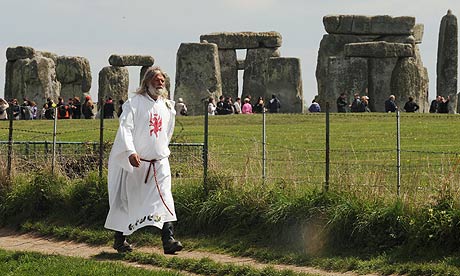
This is King Arthur Pendragon.

He legally changed his name.

He’s a modern druid and a protester at Stonehenge. He hangs out and talks very rationally about his mission. I've seen some documentaries with him in them, and he's a really eloquent, charismatic speaker. This is what he does.

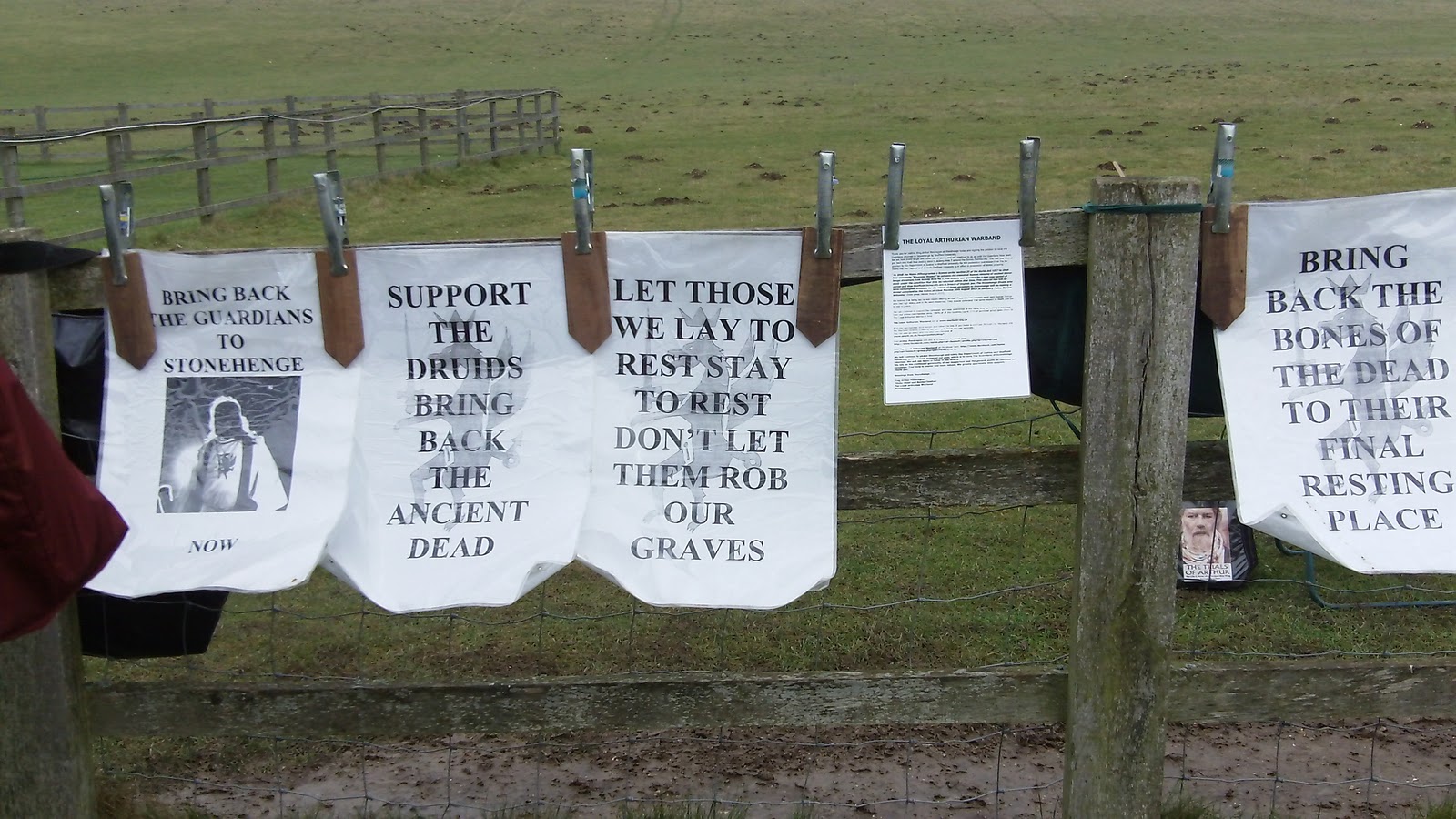
A bunch of eye-catching signs. The last one's a little off- there were no bones at the henge, just cremains.

The petition. He's got a whole binder of signatures with name, country of origin, and religion to show that it's not just an English thing or a druid thing- it's everybody's concern.
He’s been working to increase public access to the stones and the preservation of the human burials at Stonehenge for the past fifteen years. “But!” you say. “There are no human burials at Stonehenge! You’ve messed up a simple archaeological truth.” Bollocks, I say to you. There are human remains at Stonehenge. They’re here. Or rather, they were.
If you're going to mark a gravesite, do it right. (This is not the right way to do it.)

This is an Aubrey hole, first discovered by John Aubrey in 1666 and rediscovered by Robert Newell in the 1920s. These are holes in the ground where human cremains were found. All of the cremains were removed by Hawley, studied, and then reinterred into Aubrey Hole 7… for a while. They were re-removed in 2008, and they’ve been King Arthur’s pet cause since then. The British Museum has them for study, and he’s worried that they won’t give them back. After all, they were supposed to be back by now, but the museum repetitioned for ten more years and got them. It does make sense that they got them- they’re one of the world’s premiere research institutions. If any information can be gleaned from these remains, then they should of course hold them and study them. But the thing is? There’s really not much we can learn from these. Cremains are difficult to analyze. There’s not much you can learn from calcined bone about who a person was. Furthermore, these cremains are all mixed up due to the… not exactly forward-thinking archaeological practices of the 1920s. Any information we could get from them would be tainted. Sure, we might develop better techniques later on, but what’s the point in holding claimed cremains in a museum? After all, these are to the Brits what Native Americans are to Americans. They were here first, and there are some people who can claim them as biological ancestors. Many more can claim them as spiritual ancestors. The people who want the cremains to go back in the Aubrey Holes are fine with having them placed in a sealed container to be dug up later. They’re fine with the museum keeping a sample. All they want is for their ancestors to come home. That’s what the Native Americans wanted back in the 1970s. What they got was NAGPRA. It’s not perfect, but at least it’s something. There's nothing like that here. It's interesting the way they run their sites here. At many current excavations, there are rules that say that amateurs must be allowed to assist and that digging must stop to give public tours of the site. Stonehenge, which is managed by English Heritage, is a living site. There are sheep roaming around and loads of birds.

Seriously, there's a whole flock of them. Those are barrow graves in the background, by the way. More on them in a bit.

 Here is a video with some narration. Hopefully this is less terrible than my other videos.


This is Petulant Crow. He's a very friendly bird! (I think he's actually a rook, not a crow.)

Honestly, Stonehenge really does a poor job explaining the place’s role as a burial site. The Aubrey Holes are poorly marked- just white painted circles on the ground. A footpath goes right over one of them, and if you don’t have the audio tour (I didn’t, I don’t like the things) and aren’t a mortuary anthropologist or somebody with similar knowledge, you won’t know what they are. The barrow graves, on the other hand, are amazing. They’re these great hillocks in the middle of a field. Like the Aubrey Holes, if you didn’t know what they were, you wouldn’t. Unless, of course, you wandered up there.
See those hills? That's where we're going.

A fence to keep the sheep out. Normally, you can go in.


A barrow grave.
Civilization is right down the lane...
And on the other side of the hill.
A barrow grave, for those who don’t know, is a mass grave that’s basically a hollowed-out hill, sometimes surrounded by a ditch. Once they were filled with grave goods as well, but those were lost to antiquarians in the 18th and 19th centuries. It’s… so different from Stonehenge. You feel like you’re a part of the landscape. The barrows are managed by the National Trust, and they do a beautiful job of presenting them as part of the landscape. There’s a sign, a lovely illustrated unobtrusive sign, and it’s so silent and peaceful. Usually, the barrows are accessible to people; however, every now and then they fence them off to let the grass repair itself. We went when they were closed. A pity; I would rather have liked to climb one. After Stonehenge, we moved on to Bath, where there is a gorgeous Roman temple complex.

The sign! That's new. Not Roman. Not Roman at all.

Left to right: Anna, Kelly, me.

Even though the water here is green, it's very ferrous. Tastes like suckin' on nails.
This is the pediment from the temple to Sulis Minerva. Fun fact: one of the finds here were a bunch of curse tablets. I couldn't get any pictures of them, but they were written backwards on metal and tossed into the water. Mostly they dealt with the theft of clothes while the curser was bathing.
They do a neat reconstruction of the pediment with lights. The first step is putting it all to rights in classic white marble...
And then they paint it up much like it would have been.
 There were several burials at the site, and the museum has an entire room devoted to recovered tombstones. I didn’t have time to photograph all of them, but here are some.

This is the tombstone of a scribe- you can tell from the scroll he's holding.
Part of a really cool tombstone with a dog on it that's bringing in a deer.
More fragmentary tombstones.

As you can see, these are pretty elaborate memorials. These are often upper-class Romans, many of them soldiers or religious figures. And then we have this guy.

Even without looking at the sign, I guessed that this was an older adult male skeleton.
The sign told me he was a man in his 50s from Syria. See, I did learn something in forensics. They’ve got him laid out, then his shroud beneath him, and then his stone sarcophagus set in the floor, roughly in the location it was found. A good deal of the stuff he was buried with surrounds him. Now, there’s certainly no public outcry over him.  Nobody’s asking for him to be returned to the ground, or for his remains to be repatriated. So what’s the difference between him and the cremains? Is it that we can learn something from his skeleton, more than we could from the cremains? Is it that he’s on display so that the public can see him and learn from his bones? Is it that he’s not an ancestor- he’s not a Celt, or really even a Roman. He’s all the way from Syria.


A few final things to ponder: Who has the right to decide what to do with the graves, grave goods, and bodies beneath? The archaeologists who dig them up? The government? Their descendants? What do you think? How would you feel if it was your remains on display?